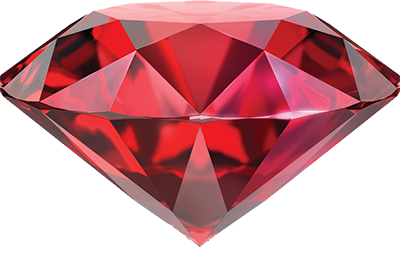
RUBY is a red corundum gemstone, prized for its beauty, hardness, and association with strength, vitality, and love. It’s known for its vibrant red color, which results from the presence of chromium. Besides being used in jewelry, rubies have various other applications, including in watchmaking, medical instruments, and lasers due to their strength and red fluorescence.
Physical Properties:
Hardness:
Rubies are extremely hard, with a rating of 9 on the Mohs scale, making them durable and suitable for jewelry.
Color:
The red color of rubies is caused by the presence of chromium in the corundum crystal structure.
Luster:
Rubies have a high luster, comparable to diamonds, making them dazzling and attractive.
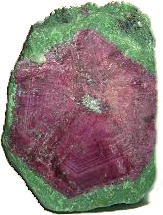
Pleochroism:
Ruby exhibits pleochroism, meaning its color appears to vary when viewed from different directions.
Chemical Composition:
Rubies are scientifically known as corundum, a crystalline form of aluminum oxide (Al2O3).
Formation:
Ruby deposits are found in various regions, including Southeast Asia, Eastern and Southern Africa, the Middle East, and others.
Uses and Applications:
Jewelry:
Rubies are a highly sought-after gemstone for their beauty and durability, making them popular for rings, necklaces, and other jewelry.
Watchmaking:
Rubies are used in watchmaking as jewels in the movement, providing a durable and low-friction pivot point.
Medical Instruments:
Rubies are used in surgical instruments and other medical devices due to their hardness and resistance to wear.
Lasers:
Rubies are used in lasers, particularly in ruby lasers, which emit a red light.
Other Applications:
Rubies are also used in abrasives, wear-resistant coatings, and various other industrial applications.
Cultural and Symbolic Meanings:
Ancient Civilizations:
Rubies were highly valued by ancient civilizations, associated with royalty, power, and protection.
Religious Significance:
Rubies have religious significance in various traditions, symbolizing the divine sacrifice of Christ in Christianity.
Symbol of Love and Passion:
Rubies are often associated with love, passion, and vitality due to their vibrant red color.
Protection and Good Fortune:
In some cultures, rubies are believed to protect against evil and bring good fortune.
Ruby mining in Tanzania is primarily concentrated in the northern and central regions, with notable deposits found in Longido, Lossongonoi, and Morogoro. While small-scale operators dominate the industry, larger operations are involved in some deposits like Lossongonoi. Recently, fine quality rubies have also been reported from the Rukwa Province in the southern highlands.
Key Regions and Mines:
Longido:
Discovered in 1914, Longido is a significant ruby mining area near the Tanzania-Kenya border.
Morogoro:
Ruby and spinel deposits were discovered in the Morogoro region in 1986.
Winza:
Since 2007, rubies and sapphires have been mined from eluvial and primary deposits in Winza, central Tanzania.
Rukwa Province:
Recent reports have highlighted the discovery of fine quality rubies in the Rukwa Province.
Other Notable Deposits:
Songea, Mahenge, and Tunduru are also known for ruby and other gemstone deposits, according to Ruby International and Gem Adventurer.
Mining Methods:
Small-scale:
Small-scale operators, often working with hand methods, are responsible for a large portion of the mining activity in Tanzania.
Large-scale:
Large-scale operations, like the one at Lossongonoi, are also involved in mining.
Eluvial and Primary Deposits:
Rubies and sapphires are mined from both eluvial (secondary) and primary deposits.
Hard Rock Mining:
In some areas, like in Longido, mining involves working hard rock tunnels, using drills and jackhammers to remove the ruby, according to MDPI and ResearchGate.
Ruby Characteristics:
Distinctive Violet Tinge:
Tanzanian rubies often have a unique violet tinge, adding to their distinctiveness.
Winza Rubies:
Winza rubies are characterized by a high Fe content and unique bluish violet color zones.
Inclusions:
Top-quality Winza rubies have distinct inclusions like long tube-, fiber-, needle-, or hair-like inclusions.
Global Market:
Global Interest:
Tanzania’s rubies are known in the global market, with interest from both large-scale and small-scale players.
Competition:
Tanzania faces competition from other ruby-producing regions, such as Montepuez.
Ethical Mining:
Focus on Ethical Practices: Some mining companies, like Ruby International, prioritize ethical mining practices.